
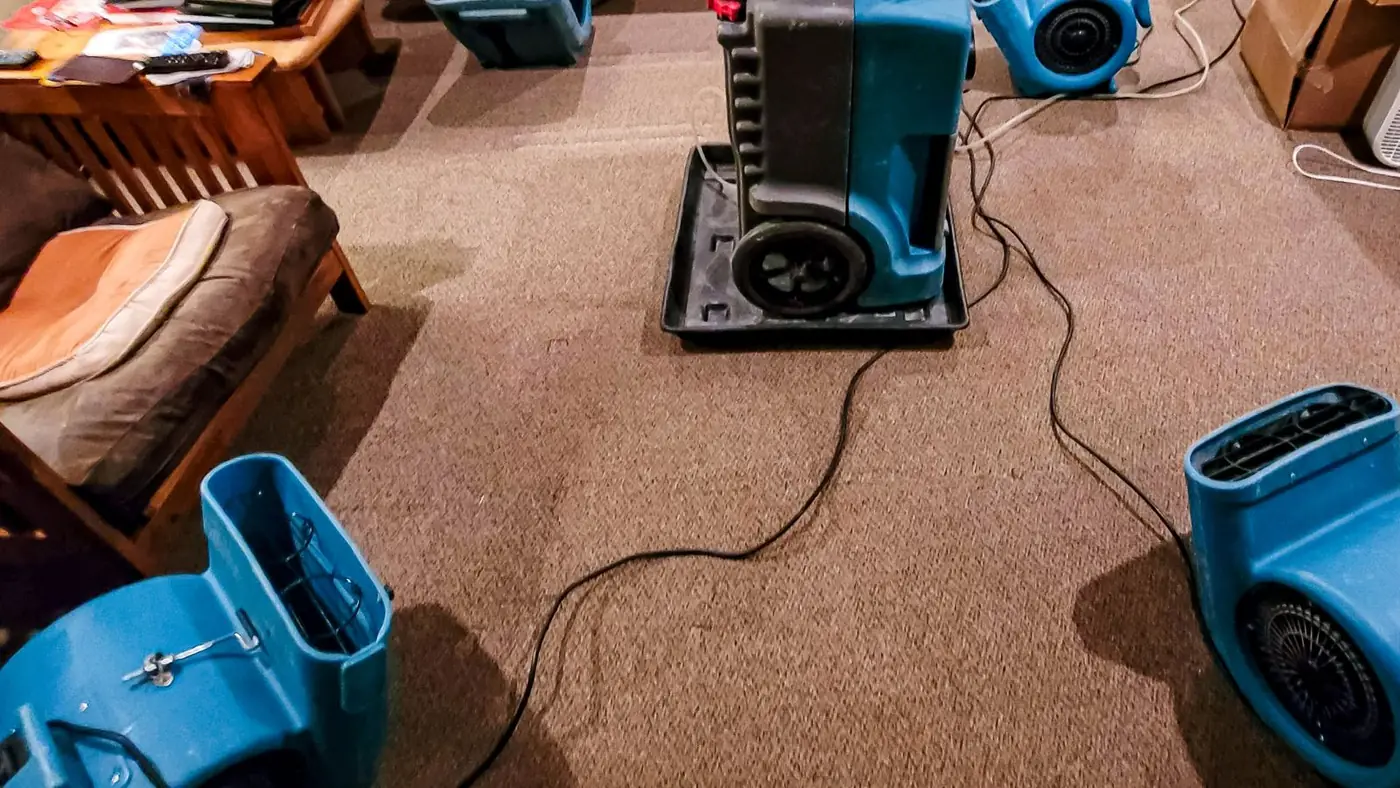
What structural drying means
Structural drying is the controlled removal of moisture from the building itself: floors, walls, framing, subfloor, cabinets and insulation. It starts after the standing water is extracted and ends when each material reads dry against a goal, not when the room feels comfortable.
Most homeowners need it after a burst pipe, a leaking appliance, a roof leak or a sewer backup that has been cleaned. If wet materials stay wet past the first day or two, mold and rot become real risks, which is why water mitigation is a service of its own.
Step one is mapping, not equipment
A good crew does not just drop fans. It first finds where the water went. Technicians use moisture meters on drywall, wood and concrete, and thermal imaging cameras to scan walls, ceilings and floors for cool, wet patches. The readings are recorded on a sketch of each room.
This moisture map matters because water travels. A pipe leak in a hallway can wick into the closet behind it and under the baseboard of the next room. The map shows the full footprint, which sets how much equipment the job needs.
The sequence of a drying job
- Extraction of standing water and water in carpet and pad.
- Removal of materials that cannot be dried, such as soaked insulation or ruined pad.
- Placement of air movers to push dry air across wet surfaces.
- Placement of LGR dehumidifiers to pull moisture out of the air.
- Drying of wall cavities, using small holes, vents or injectidry panels.
- Daily checks, with equipment moved and added as readings change.
Extraction comes first because pulling water as liquid is far faster than evaporating it. Every gallon removed by an extractor is a gallon the dehumidifiers do not have to handle.
How long drying usually takes
| Material | Typical drying time | Why |
|---|---|---|
| Carpet and pad (clean water) | About two to three days | Thin and porous, dries fast once extracted |
| Drywall | Three to five days | Gypsum wicks water upward, cavities slow it |
| Wood framing and subfloor | Three to five days or more | Dense and slow to release moisture |
| Hardwood flooring | Often a week or more | Wood releases moisture slowly to avoid cracking |
| Plaster and thick insulation | Longer than drywall | Hold more water and dry from the surface in |
| Concrete slab | Longer still | Very dense, can lag behind everything else |
Most house drying runs three to five days, longer for hardwood, plaster or thick insulation. The number depends on how long the water sat, how much it spread, and the water category. Do not hold a crew to the first estimate, because the readings decide when it ends.
Water extracted but walls still damp?
Call 24/7 dispatch for moisture mapping and a drying plan with daily readings.
Call (909) 505-3870Wall cavities and the places you cannot see
Drywall can look fine on the surface while the bottom of the wall cavity holds water. Crews drill small holes along the baseboard, pop off the toe-kick, or use injectidry panels to push dry air into the cavity. This avoids tearing out walls that can be saved.
If insulation inside the wall is soaked, it often has to come out, because it stays wet for a long time and dries slowly. Contaminated water, such as sewage, changes the plan. Porous materials that touched Category 3 water are normally removed instead of dried.
What a drying log shows
- The date and time of each visit, with the readings taken.
- The moisture level at each marked point on the map, day by day.
- The reference reading from an unaffected area, which is the dry goal.
- Temperature and humidity in the room and from the dehumidifier exhaust.
- The list of equipment placed and any changes made.
The log is your proof. It shows the numbers falling toward the dry goal, and it is the document an insurer or a buyer's inspector will want to see. Ask for a copy when the job ends.
How to tell drying is finished
Drying is done when every wet material reads at or near the dry standard you set at the start, on consecutive days, and the equipment can be removed without readings climbing back. ANSI/IICRC S500 is the published water damage restoration standard, and its drying goals are based on comparing wet readings to dry reference readings in the same home. Ask any company whether its crews work to S500.
A surface that feels dry means little. If the crew cannot show readings, you do not know whether the framing is dry, and that is where mold starts.
What not to do
- Do not rely on household floor fans. They move air in the room but cannot dry a wall cavity.
- Do not close the house up tight while drying runs. Moisture needs somewhere to go, and the crew will tell you which rooms stay closed.
- Do not turn off the equipment overnight because it is loud.
- Do not paint, seal or install new flooring before the final readings.
- Do not skip the insurance call because the water looks gone.
Equipment noise and the electric bill are real, so ask the crew what to expect. Reasonable emergency drying costs can be reimbursed under many policies, so check your policy, ask your insurer, and keep receipts. Our water damage repair team handles drywall, flooring and paint once the drying log is signed off.
Water Damage Notes for Loma Linda
We serve two ZIP codes in the city, 92354 and 92350, so tell dispatch which one applies to your address. That helps a crew confirm the location when you call about drying equipment for a home near the university or along Barton Road.
Loma Linda borders San Bernardino to the north, Redlands to the east, Colton to the west and Riverside County to the south. If your address is near a city edge, give the cross streets as well, since a unit just across the line may be in a different city's service area and utility.
Neighboring cities
Drying projects also come from the north and northwest. See the San Bernardino water damage page and the Grand Terrace page for local details in those areas.
Structural drying questions
Can I rent air movers and dehumidifiers and do it myself?
You can run equipment, but you need meters and a moisture map to know where to place it and when you are done. Without readings, you risk leaving wet framing behind walls.
Why is it so loud and warm in my house?
LGR dehumidifiers pull water from the air and give off heat, and air movers run all day. That warmth and airflow speeds drying, so the noise is a sign the equipment is working.
Will the crew cut holes in my walls?
Sometimes small holes at the baseboard or toe-kick, so dry air can reach the cavity. They are patched in the rebuild.
Does mold grow while the house is drying?
Mold needs moisture, and drying wet materials within about 24 to 48 hours helps prevent growth. If mold is already present, ask about mold remediation following S520 practice.
Which Loma Linda ZIP codes do you cover for drying services?
We cover 92354 and 92350, along with the neighboring cities listed on our service pages. Call dispatch with your address and they will confirm.